Buy Crypto With a Bank Transfer: ACH, Wire, SEPA and Faster Payments Compared
A bank transfer is usually the cheapest way to buy crypto, because it skips the card network and the fees that come with it. On Kraken, ACH, FedWire, SEPA and UK Faster Payments deposits are all free (funding page last updated 1 Oct 2026, read 9 Oct 2026), while a debit-card deposit costs $0.25 plus 3.75%. What you trade for the saving is time, and the timing rules are less obvious than most guides suggest: Kraken credits an ACH deposit for trading almost at once, then blocks withdrawals of what you bought for seven days.
This route suits anyone who plans to buy more than once, or to buy a meaningful amount, and who can wait a few days before moving coins to their own wallet. It is the wrong route if you need the coins in your own wallet today, or if your bank routinely blocks payments to crypto firms. Below, each rail is compared on fee, speed and hold, with the dates we checked them.
Why a transfer costs so much less
When you pay by card, the exchange pays card-network and processing costs and passes them on, which is why card deposits carry percentage fees. A direct bank payment avoids that layer, so a regulated exchange can afford to accept it free. The spread still applies when you buy, as it does with every method, so the honest comparison is always the amount of crypto you receive against the cash that left your account. On the funding line alone, though, the bank transfer wins: zero against 3.75% plus $0.25 on Kraken is not a close contest.
The saving scales with the purchase. On $500, Kraken's debit-card deposit fee would be $19.00 before you buy anything; the same $500 sent by ACH or SEPA costs nothing to deposit. Spend that difference every month and the case for patience makes itself.
The common rails: ACH, wire, SEPA and Faster Payments
Which rail you use depends on where you bank, and each balances cost against speed in its own way. These are Kraken's published terms; other exchanges set their own, and Coinbase's could not be confirmed for this check:
- ACH (US): free, from $1, linked through Plaid. Funds are available to trade near-instantly, but coins bought with them cannot be withdrawn for seven days.
- FedWire (US): free on Kraken's side, from $1, arriving in 0 to 1 business days with no withdrawal hold. Your own bank may charge its outgoing wire fee.
- SWIFT (international): free with a $100 minimum through one receiving bank (1 to 3 business days), or a $3 fee with a $4 minimum through another (1 to 5 business days).
- SEPA and SEPA Instant (eurozone): free, from €1, arriving in 0 to 3 business days, or in seconds where your bank supports SEPA Instant. iDEAL in the Netherlands is free from €10.
- Faster Payments (UK): free, from £1 through Plaid (£2 through Kraken's other UK banking partners), arriving in 0 to 1 business days; a first deposit can take 1 to 3.
Canadian readers will look for Interac e-Transfer here. We could not verify current Interac terms at a partner exchange on the day we checked, so we have left it out rather than guess. The same logic applies wherever you bank: the cheap domestic rail almost always beats a card, and the details that bite are minimums and holds, not the headline fee.
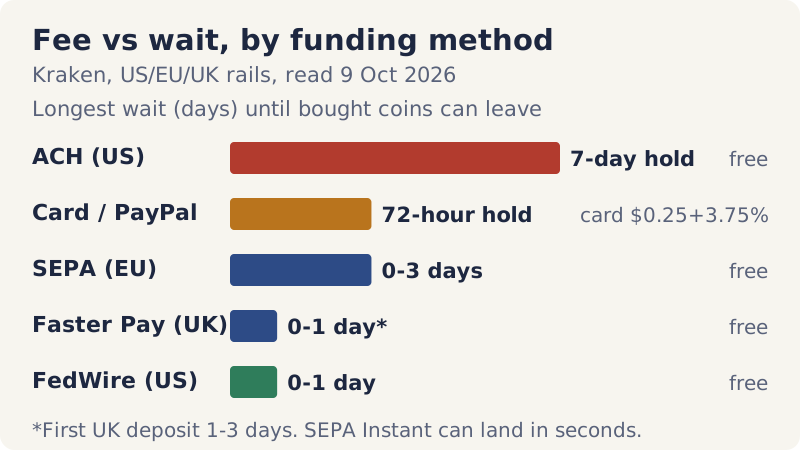
The chart shows the trap in the cheapest-looking option. ACH is free and lets you trade at once, which feels like the best of both worlds, until you try to send what you bought to your own wallet and meet the seven-day hold. A domestic wire costs your bank's outgoing fee but clears with no hold at all, which can make it the better choice for a larger purchase you want in self-custody quickly.
Rail by provider: fees, speed and holds, side by side
Bank-transfer support differs more between providers than card support does. Here is what we could confirm on each provider's own pages on 9 Oct 2026:
| Rail | Kraken | MoonPay | Paybis | Coinbase |
|---|---|---|---|---|
| ACH (US) | Free, $1 min, near-instant; 7-day withdrawal hold | Not offered for buying (selling only) | Supported; first buy carries no Paybis fee; $5 to $20,000 | Not confirmed |
| FedWire (US) | Free, $1 min, 0-1 business days, no hold | Not listed | Not checked | Not confirmed |
| SWIFT | Free ($100 min) or $3 fee ($4 min), 1-5 days | Not listed | Not checked | Not confirmed |
| SEPA / SEPA Instant | Free, €1 min, 0-3 business days or instant | Accepted in the EU, 1-3 business days; no Wise or C24 senders | Not checked | Not confirmed |
| Faster Payments (UK) | Free, £1 min, 0-1 business days (first 1-3) | Accepted in the UK, about 1 business day | Not checked | Not confirmed |
Read the gaps as gaps. Coinbase's help centre says only that a funding fee may apply depending on the payment method, and we could not confirm its hold rules, so we print no Coinbase numbers; the app shows both before you confirm a deposit. Paybis publishes a service fee, typically at least $2, that it says is generally lower for bank transfers, but no percentage per rail. For a bank-funded exchange account with published, free deposits, Kraken is the clearest option we found, except in New York and Maine, where it does not operate. Coinbase is the obvious alternative to compare inside its app, and for a single ACH purchase sent straight to your own wallet, Paybis skips the exchange account altogether. All three are affiliate links; we may earn a commission, and it does not change the table.
Step by step: link a bank, deposit, buy, withdraw to your wallet
- Verify your exchange account first. Deposits from an unverified account, or from a bank account in someone else's name, are commonly rejected.
- Choose the rail inside the app. Pick ACH, wire, SEPA or Faster Payments from the deposit screen, and note the minimum and any hold it shows before you send.
- Copy the deposit details from that screen only, including any reference code, exactly as shown. A missing reference is a common reason a transfer gets stuck.
- Send a small first transfer to prove the route works, then the full amount.
- Buy once the funds show, using a limit order on the Pro screen if you want to avoid the app's 1% fee and spread.
- Withdraw to your own wallet when any hold has passed, after a small test withdrawal on the right network.
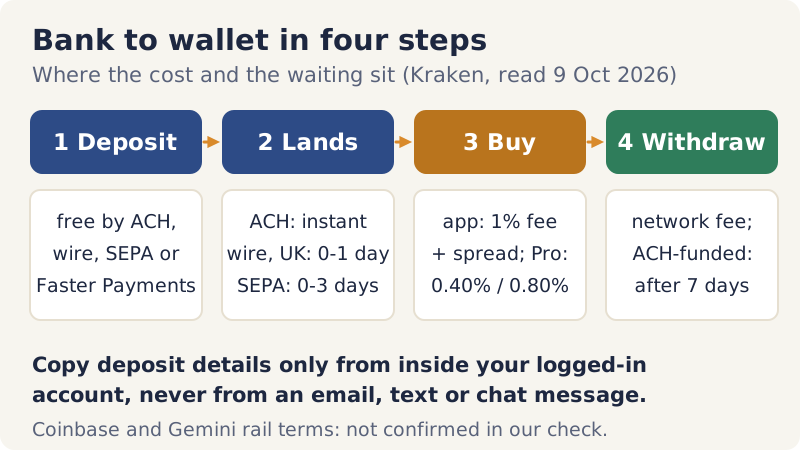
The order matters more than any single step. The avoidable failures tend to start with a deposit copied from the wrong place or sent before the account was verified, or with a withdrawal attempted before a hold has ended. For the wider sequence, including choosing a provider and setting up a wallet, see the full guide to buying crypto safely.
Common bank-transfer problems and how to fix them
Most failed or delayed transfers come down to a mismatch, a hold or a cautious bank. A mismatch happens when the name on the bank account differs from the name on your verified exchange account; fund only from an account in your own name. Some providers also refuse certain sending banks: MoonPay, for instance, says it cannot accept transfers from Wise or C24 Bank. A hold is a deliberate delay, such as Kraken's seven days on ACH-funded withdrawals or its note that a first Faster Payments deposit can take 1 to 3 business days.
A cautious bank is the hardest to predict. Some banks slow, query or decline payments to crypto firms, and a quick call confirming that you made the payment yourself often clears it. If a transfer goes missing, contact the exchange through its official app with your bank's payment reference, and wait for settlement before panicking: a SEPA transfer quoted at up to three business days is not lost on day two.
Wire transfers: when speed is worth a fee
A wire makes sense when you want a large deposit to settle quickly with no withdrawal hold, and a cheaper rail would make you wait. On Kraken, a FedWire deposit is free on the receiving side, arrives in 0 to 1 business days and carries no hold, so coins bought with it can leave for your own wallet as soon as the purchase settles. The cost sits with your bank, which may charge for an outgoing wire; check its fee schedule, because on a small purchase that fee can outweigh any advantage. For international senders, Kraken's SWIFT options are free with a $100 minimum through one receiving bank or $3 through another.
Wire-transfer scams that target crypto buyers
Bank transfers attract a specific kind of fraud: someone gives you bank details to pay, and the money goes to them instead of to an exchange. It can arrive as an email that looks like a deposit confirmation with updated details, a support agent in a chat who supplies an account number, or a new online friend who offers to help you buy. The CFTC describes the pig-butchering version, where a small deposit shows quick profits on a fake trading site and withdrawals are then blocked by fees you must pay first. The FBI's IC3 recorded 181,565 crypto-related complaints in 2025, with $11.366 billion in reported losses.
The defence is one rule: the only valid deposit details are the ones shown inside your own logged-in exchange account, reached by typing the address or opening the official app yourself. Never pay an account number that arrived by message, and treat any "recovery" service that contacts you afterwards as a second scam. Our guide to avoiding buy-side scams covers the other common scripts.
Recurring buys and dollar-cost averaging
Free bank deposits suit scheduled buying, where a fixed amount goes in on a set day regardless of price; the approach is often called dollar-cost averaging. It takes timing decisions and emotion out of the process, and the cheap rail stops fees from eating the habit. It is not a guarantee of profit: a regular purchase of a volatile asset is still exposed to that volatility, and an automated plan can quietly spend more than you meant to. Keep the amount small and fixed, review it regularly, and fund it only with money you could lose. If you are unsure how much that is, our page on how much to start with is a sober place to begin.
Bank-transfer crypto questions
How long does a bank transfer take to buy crypto?
How do I buy bitcoin with a bank transfer?
Why can't I withdraw crypto I bought with an ACH deposit?
Can I buy bitcoin with a SEPA bank transfer?
Can I buy Chainlink (LINK) or other coins with a bank transfer?
New here? Start with the full step-by-step guide to buying crypto safely, or compare card, debit and bank payment methods.