How to Buy Crypto With PayPal (2026): Every Route Compared
Yes, you can buy crypto with PayPal, in three different ways that are easy to mix up. In the US and the UK you can buy inside PayPal itself, where US fees run from 2.20% down to 1.50% plus an estimated 1.00% spread (checked 9 Oct 2026). Or you can use PayPal purely as the way you pay: to fund an exchange balance such as Kraken's, or to check out with an on-ramp such as MoonPay or Paybis that sends the coins straight to your own wallet.
Buying inside PayPal suits someone who wants a small amount of bitcoin or ether next to their existing balance, with no new account. The on-ramp route suits someone who wants the coins in a wallet they control. Anyone planning to buy regularly should skip all three, because a bank transfer to a regulated exchange is cheaper. And PayPal's buyer protection was built for goods, not crypto, so it is no safety net against scams.
Short answer: three routes, and they are not the same thing
The difference that matters is who holds the coins when you are done. Inside PayPal, PayPal's crypto company keeps them in your PayPal account, and you can sell them there or send them out later. Through an exchange, PayPal only tops up your exchange balance; the exchange holds what you buy until you withdraw it. Through an on-ramp, PayPal pays for a one-off purchase and the coins are sent directly to an address you supply. Same blue button, three different custody arrangements, three different fee structures.
Which one is available also depends on where you live, and the rules are stricter than most guides admit. The sections below take each route in turn, then put the costs and the country list side by side.
Route 1: buying inside PayPal (US and UK)
In the US, PayPal lets you buy seven assets: PayPal USD (PYUSD), Bitcoin, Ethereum, Litecoin, Bitcoin Cash, Solana and Chainlink, from $1. You can pay from your PayPal balance, a linked bank account or a debit card; credit cards and PayPal Credit are not allowed. The crypto is held by PayPal Digital, Inc., a New York limited purpose trust company, which uses Paxos Trust Company, N.A. as a service provider for some custody, trading and transfer work (PayPal help page and crypto terms, last updated 19 May 2026, read 9 Oct 2026).
Fees: four tiers plus a spread
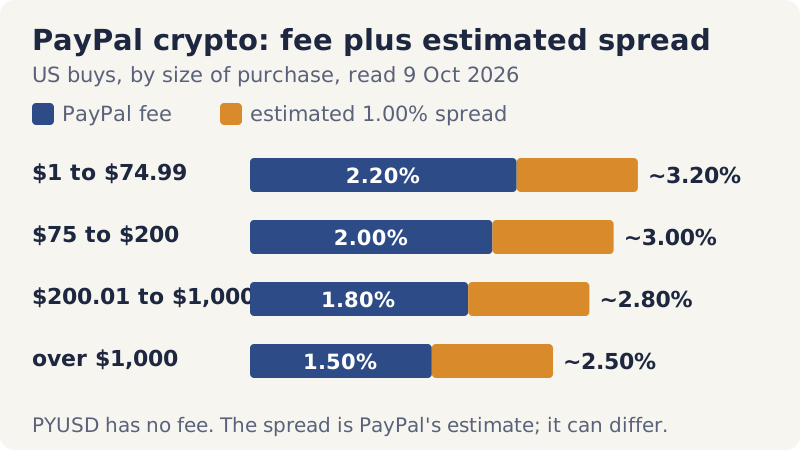
PayPal's consumer fee page sets the US buy and sell fee by transaction size: 2.20% from $1 to $74.99, 2.00% from $75 to $200, 1.80% from $200.01 to $1,000 and 1.50% above $1,000. Buying or selling PYUSD carries no fee. On top of the fee, PayPal's terms say the exchange rate includes an estimated 1.00% spread, which can be higher or lower and is not shown separately on each trade. So a $100 purchase costs a $2.00 fee plus roughly $1.00 of spread, about 3% all-in, as an estimate rather than a quote.
Limits, and sending coins to your own wallet
A PayPal-linked crypto account can buy up to $100,000 a week and send up to the equivalent of $25,000 a week; Venmo-linked accounts are capped at $20,000 a week and $50,000 over a rolling year. You can move most coins out to an external wallet, but there are minimums: 0.001 BTC, 0.01 ETH, 0.01 BCH, 0.01 LTC, 0.01 SOL and 1 LINK, with PYUSD at 10 on Ethereum or 1 on Solana, Arbitrum or Stellar. External sends pay a network fee in the coin you send, while transfers to other PayPal or Venmo crypto accounts are free. Small buys may sit below the minimum, so check it before you buy if self-custody is the plan.
In the UK, PayPal's help page says personal account holders can buy from £1 after completing a short survey; business accounts cannot, and credit cards and PayPal Credit are again excluded. The page does not list the UK coin menu, and older reports that UK buying was paused do not match the current wording (read 9 Oct 2026). We did not check PayPal's crypto availability in other countries, so treat any EU claim you read elsewhere with care.
Route 2: exchanges that take PayPal as a payment method
Kraken accepts PayPal deposits in the US, the EEA, the UK and Australia, from one unit of currency, credited almost instantly. Its funding page says PayPal's processing fees vary by region and appear on the final confirmation screen, and that a PayPal deposit triggers a 72-hour withdrawal hold (Kraken support article, last updated 1 Oct 2026). Once the money lands you buy at Kraken's own prices: 1% plus a spread on an app instant buy, or 0.40% maker and 0.80% taker at Kraken Pro's entry tier. Kraken does not serve New York or Maine.
Coinbase is the name most people expect here, and we cannot give you a straight answer. None of its help pages we could read for this check settles it, so we could not confirm whether the Coinbase app currently accepts PayPal for buying in your country. The one Coinbase page we could read, the developer documentation for its embedded Onramp, lists PayPal only for selling, in select countries. Check inside the app before assuming either way. If PayPal-funded exchange buying is what you want, Kraken is the route we could confirm; it is an affiliate link, and the 72-hour hold applies whichever way you arrive.
Route 3: on-ramps that take PayPal at checkout (MoonPay, Paybis)
An on-ramp skips the account-and-balance step: you pick a coin, paste your wallet address, pay with PayPal and the coins are sent to you. MoonPay's help centre lists PayPal for buying in the US, the UK and the EU except Croatia, Hungary and Iceland (article dated 26 Aug 2026). Its pricing disclosure caps the MoonPay fee at 4.5%, with a minimum fee of up to $3.99, and adds the network fee and any spread built into the price (read 9 Oct 2026).
Paybis accepts PayPal in most of the EEA, with Iceland, Hungary and Croatia excluded, as well as in the US and the UK, and lets you pay in nine currencies: USD, EUR, GBP, CZK, DKK, PLN, SEK, CHF and NOK. It says PayPal fees vary and shows them once you enter an amount; its general fee note describes a service fee that typically starts at $2, plus the network fee. Expect identity checks on either service. For a one-off purchase into your own wallet, compare a quote from MoonPay with one from Paybis for the same amount; both are affiliate links, and the cheaper final crypto amount should win regardless.
Fee comparison: a $100 buy across the three routes
Only some of the cost is knowable before checkout, so the chart shows what each provider publishes and marks what it does not. Inside PayPal, the fee and the estimated spread are both disclosed, which makes it the most predictable route at about $3.00. MoonPay publishes a ceiling rather than a price. Kraken's own fee is low, but PayPal's processing charge on the deposit is only revealed at confirmation. Paybis publishes no percentage for PayPal at all.
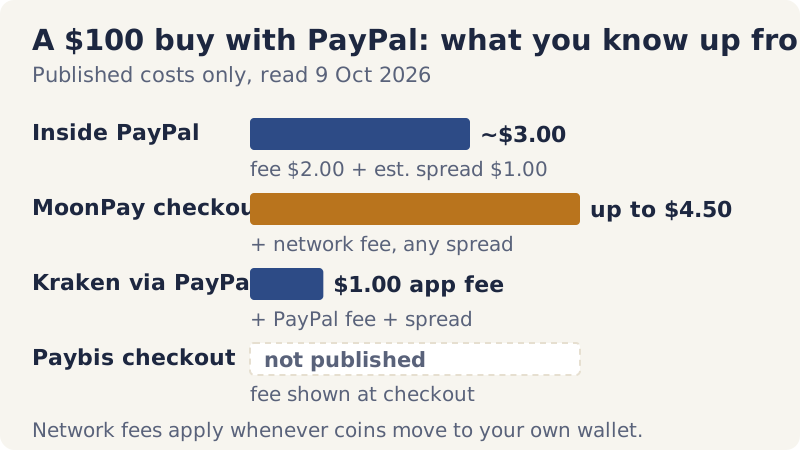
Two things the chart cannot show also matter. Coins bought inside PayPal still need a network fee and a minimum balance to leave PayPal, so the cheapest route on paper can be the most awkward one if you want self-custody. And a Kraken deposit by PayPal is locked for 72 hours before anything can be withdrawn. Compare the crypto you end up holding, where you want it held, rather than the headline percentage.
PayPal buyer protection does not cover your crypto
PayPal's Purchase Protection list of ineligible items includes "financial products or investments of any kind", and its crypto terms promise protection only against unauthorised purchases or sales in your crypto account (buyer-protection page last updated 26 Jan 2026). Buying crypto is not buying goods, and the crypto terms add that virtual-currency transactions are irreversible and "are used by persons seeking to defraud customers". In plain terms: if you send coins to a scammer, PayPal is not going to claw them back for you.
That shapes the scams. Someone you met online asks you to buy crypto in PayPal and send it to their address. A caller claiming to be PayPal support says your account is at risk and you must move your coins somewhere safe. A recovery firm promises to get back what you lost, for a fee. Fake fund-recovery services drew 10,516 complaints to the FBI's IC3 in 2025, with $1.4 billion in losses. Any of these is a reason to stop, hang up and contact PayPal yourself through the app.
Which countries can use which route
Here is the availability we could confirm on the providers' own pages, with gaps marked rather than guessed:
| Route | US | UK | EU / EEA | Watch for |
|---|---|---|---|---|
| Inside PayPal | Yes, 7 coins | Yes, personal accounts after a survey | Not checked | No credit cards or PayPal Credit |
| Kraken, PayPal deposit | Yes, except NY and ME | Yes | Yes | 72-hour withdrawal hold; also Australia |
| MoonPay, PayPal checkout | Yes | Yes | Yes, except Croatia, Hungary, Iceland | Fee up to 4.5% + network fee |
| Paybis, PayPal checkout | Yes | Yes | Most, except Iceland, Hungary, Croatia | Fee shown at checkout |
| Coinbase app | Not confirmed | Not confirmed | Not confirmed | Not confirmed on any help page we could read |
If you live in Croatia, Hungary or Iceland, both on-ramp routes are closed, which leaves an exchange that accepts PayPal or, more cheaply, a bank transfer. For a full walk-through of how a first purchase works from start to finish, see our guide to buying crypto safely.
Which route should you use?
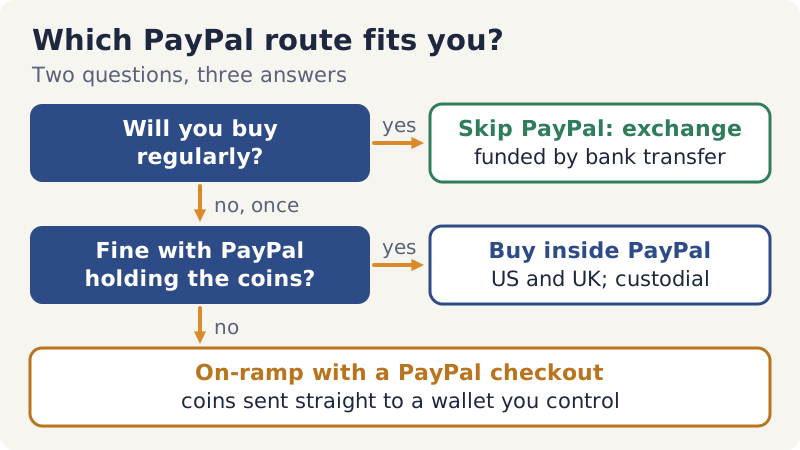
Start with frequency. If you expect to buy every month, none of the PayPal routes is the right base: a regulated exchange funded by bank transfer costs less. For a single purchase, the question is custody. If you are content for PayPal to hold a small amount and you are in the US or UK, buying inside PayPal is the simplest option and its costs are disclosed up front. If you want the coins in your own wallet from day one, an on-ramp with a PayPal checkout does that in one step. Our page on buying crypto with a bank transfer explains, rail by rail, why that route costs less.
Taxes: selling or swapping counts
For US readers, the IRS treats selling, exchanging or otherwise disposing of a digital asset as something you report; the Form 1040 question asks about it directly. US brokers must report gross proceeds of digital-asset sales on Form 1099-DA for transactions from 1 Jan 2025, and cost basis for certain transactions from 1 Jan 2026 (IRS digital assets page, read 9 Oct 2026). Spending crypto held in PayPal at a merchant is a disposal too. Keep your own records of what you paid, and treat this as general information rather than tax advice.
Risks and what can go wrong
The price can fall the day after you buy, and a 3% entry cost means you start slightly behind. A purchase smaller than PayPal's external-send minimum can leave coins you cannot move to your own wallet without buying more. A PayPal-funded exchange deposit locks withdrawals for 72 hours. A wrong address or network on any external send loses the coins for good. Our guide to first-time buyer mistakes covers the slips we see most, and the scam patterns aimed at new buyers are worth five minutes before you send anything anywhere.
Buying crypto with PayPal: common questions
Can I buy crypto with PayPal?
How do I buy bitcoin with PayPal?
Can I buy Ethereum with PayPal?
Does Coinbase accept PayPal?
Can I send crypto from PayPal to another wallet?
New here? Start with the full step-by-step guide to buying crypto safely, or compare card, debit and bank payment methods.