How to Buy XRP Safely: Step by Step (US, UK and EU)
To buy XRP, use a regulated exchange or on-ramp that lists it where you live, such as Kraken (outside New York and Maine) or MoonPay, fund it by bank transfer where you can, and take care with two XRP-specific details if you move the coins. Any XRP you send to an exchange needs that exchange's destination tag, and a self-custody XRP wallet keeps 1 XRP locked as a base reserve, plus 0.2 XRP for each extra object such as a trust line, per the XRP Ledger documentation (read 9 Oct 2026).
This guide covers the mechanics of buying and moving XRP, not whether you should own it; we do not make price calls. It is written for first-time buyers in the US, UK and EU who want to avoid the mistakes that are specific to this coin. If you arrived here because of a giveaway, a price prediction or someone promising a return, stop and read the scam section first.
Short answer: buy on a regulated platform, withdraw with the right tag
The buying part is ordinary. You open and verify an account on an exchange or on-ramp that lists XRP in your region, fund it, place an order and receive XRP in your account or wallet. What makes XRP different is the XRP Ledger's design: exchanges receive deposits for many customers at one shared address and tell them apart with a number called a destination tag, and every XRP account must keep a minimum balance, the reserve, that it cannot spend. Get those two right and XRP is no harder to handle than any other coin.
One legal note, because it still circulates as hype. The SEC's case against Ripple ended on 7 Aug 2025, when both sides' appeals were dismissed; the court's 7 Aug 2024 final judgment stands, including a $125,035,150 civil penalty and an injunction against Ripple (SEC litigation release LR-26369). That outcome concerns Ripple the company. It is not a blanket ruling on XRP, and it says nothing about XRP's future price.
Where you can buy XRP by region
Availability depends on the platform and on where you live, and in the US it can differ by state. This is what we could confirm on the providers' own pages:
| Platform | Sells XRP? | Where | Published buying fees | Withdrawal fee |
|---|---|---|---|---|
| Kraken | Yes | Where Kraken operates ("geo restrictions apply"); not in New York or Maine | App 1% + spread; Pro 0.40% maker / 0.80% taker | 0.05 XRP; minimum withdrawal 12.05 XRP |
| MoonPay | Yes | Its XRP page says 150+ countries | Fee up to 4.5% (min. fee up to $3.99) + network fee | Sent straight to your wallet |
| Coinbase | Yes (its US buy page lists XRP) | Check the app for your state or country | Fee calculated when you order; no % published | Network fee shown before you send |
| PayPal (US) | No | XRP is not among the 7 assets PayPal sells | n/a | n/a |
New York is a special case. The NYDFS Greenlist, which lets licensed firms list coins without separate approval, currently covers bitcoin, ether and six approved stablecoins, including Ripple USD; XRP itself is not on it (read 9 Oct 2026). Firms with a DFS-approved coin-listing policy can list other coins, so New York XRP menus vary by platform and Kraken does not serve the state at all. Coinbase's US buy page lists XRP but publishes no fee for it (read 10 Oct 2026), so open the app to see whether XRP is offered where you live and what an order costs. In the UK and EU, check that the platform is registered with the FCA or authorised under MiCA before you deposit.
Step by step: buying XRP on an exchange
- Open an account on a regulated platform that lists XRP in your region, reached by typing its address or from the official app store.
- Verify your identity. Expect to provide ID and proof of address before you can deposit.
- Fund it cheaply. A bank transfer (ACH, wire, SEPA or Faster Payments) is free on Kraken; a debit card costs $0.25 plus 3.75% there.
- Buy XRP. The app's instant buy is simplest at a 1% fee plus spread; a limit order on the Pro screen costs 0.40% as a maker.
- Decide where to keep it. Leaving it on the exchange is custodial; moving it to your own wallet means handling the reserve and, later, destination tags.
- Send a small test withdrawal first, confirm it arrives, then move the rest.
Two points are easy to miss. Coins bought with a Kraken ACH deposit cannot be withdrawn for seven days, and card or PayPal deposits carry a 72-hour hold, so plan the move to your own wallet around that. And the network matters: choose the XRP Ledger network for XRP withdrawals, because a wrapped or bridged version on another chain is a different token. If you prefer Kraken, it publishes every fee above; for a direct card or Apple Pay buy into your own wallet, MoonPay sells XRP. Both are affiliate links, and a commission does not change our view.
Sending XRP to your own wallet: destination tags and the reserve
A destination tag is a number that identifies, at a shared XRP address, the customer a payment is meant for. Exchanges use one or a few addresses for everyone and rely on the tag to credit the right account. Per the XRP Ledger documentation, an address can set a flag called RequireDest, in which case the ledger rejects any payment that arrives without a tag instead of accepting money nobody can attribute. Not every exchange sets that flag, so a deposit sent without the tag may land unassigned and need a support claim, which means it may be lost or delayed.
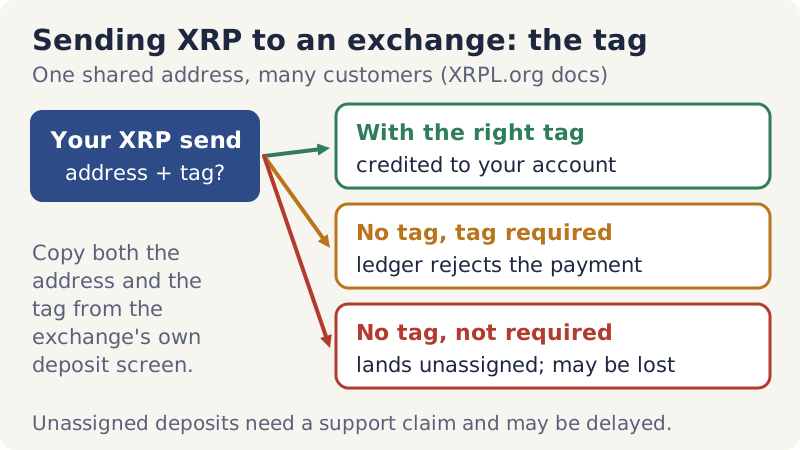
The practical rule: when you send XRP to an exchange, copy both the address and the tag from that exchange's own deposit screen, and paste both. When you withdraw from an exchange to your own self-custody wallet, you normally do not need a tag, because the address is yours alone; if your wallet shows one, include it.
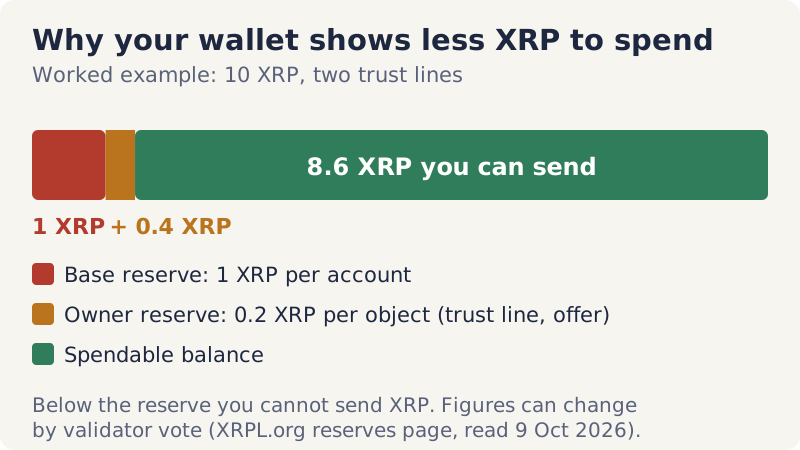
The reserve is the other surprise. The XRP Ledger requires every account to hold a minimum balance: currently 1 XRP as the base reserve, plus an owner reserve of 0.2 XRP for each object the account owns, such as a trust line or an open offer. Below that level the account cannot send XRP. The figures change from time to time by validator vote. This is why a new wallet holding 10 XRP shows less than 10 available to send.
Fees: trading fee, spread and withdrawal fee
Three costs add up when you buy XRP and move it. The trading fee is the platform's charge for the purchase: on Kraken, 1% on an app instant buy or 0.40% maker and 0.80% taker at Kraken Pro's entry tier; on MoonPay, up to 4.5% with a minimum fee of up to $3.99, plus the network fee (all read 9 Oct 2026). The spread is the difference between your price and the market price, built into instant buys and on-ramp quotes rather than listed. The withdrawal fee is charged when you move XRP off an exchange: Kraken's table lists 0.05 XRP, with a minimum withdrawal of 12.05 XRP including the fee (read 10 Oct 2026), and the final figure appears on the confirmation screen.
The cheapest published route we found is a free bank deposit, a limit order on the Pro screen and a single withdrawal once any hold has passed. The most expensive is a small card purchase on an on-ramp, where a minimum fee can be a large share of the amount. Note the withdrawal minimum too: on Kraken you need at least 12.05 XRP to move any out, so a very small purchase may sit on the exchange until you add to it. For the full breakdown of funding rails, see our page on buying crypto with a bank transfer, and for the general method that applies to any coin beyond bitcoin, buying Ethereum and altcoins safely.
XRP-specific scams: giveaways, fake airdrops, impersonation
A handful of scam scripts use XRP as bait, and they are worth recognising on sight. The giveaway asks you to send XRP to an address so that double comes back, often in a video that impersonates a well-known executive. The fake airdrop or claim page asks you to connect a wallet or type in your secret key to receive free tokens. The fake support agent appears in replies or direct messages after you post about a stuck transfer and asks for your recovery phrase. Every one of these ends with your XRP leaving your control.
A fourth script sells yield. The XRP Ledger does not use proof-of-stake and does not pay validators, so there is nothing to stake natively (XRPL.org consensus documentation). Any "XRP staking" offer is therefore a product run by a company, with that company's risks, or a scam; it is never a feature of XRP itself. The CFTC's description of pig-butchering frauds, where small deposits show fake profits and withdrawals are then blocked by invented fees, is how fake "investment platforms" work, whichever coin they use as the hook. See our guide to avoiding buy-side scams for the other patterns.
Risks and what can go wrong
Price risk is the biggest and the one this page cannot reduce. Operational risk is the one it can: a missing tag on an exchange deposit, a withdrawal on the wrong network, or a wallet funded below the reserve. Platform risk remains while coins sit on an exchange, which is why many buyers move holdings they intend to keep to a wallet they control. Regulatory availability can change too, so re-check that your platform still serves your state or country before each large purchase. Start small, test every new route, and never let someone else supply the address you send to. Our guide to buying crypto safely puts these steps in order.
How to buy XRP: common questions
How do I buy XRP crypto?
Where can I buy XRP?
Can I buy XRP on PayPal?
What is an XRP destination tag?
Why can't I send all my XRP?
New here? Start with the full step-by-step guide to buying crypto safely, or compare card, debit and bank payment methods.